Hold the files at the scale they actually are.
Foundry120 stores research datasets in Azure cloud storage, so a study can keep terabytes of imaging, sequencing, and other files without a shared drive. The catalogue and the access rules live in the platform, next to the samples.
Onboarded with the research team.
Bringing existing sample inventories and datasets in is work we do together. Datasets are onboarded and structured with research teams, so that identifiers, metadata, and the relationships between datasets are understood before analysis.
Built for files that outgrow a laptop.
Storing a big file and governing it are separate problems. Foundry120 handles both, so a dataset can grow without leaving the platform's rules behind.
- The file itself sits in Azure cloud storage
- Its catalogue entry, access rules, and sample links stay in the platform
- Who can open a dataset follows the same study and lab rules as the rest of Foundry120
Two ways data arrives.
Most teams start with an upload. Recurring sources can be ingested on a schedule once that source is set up.
Upload
Smaller files go through the browser. Large collections upload straight to Azure with the tools the platform provides.
Scheduled ingestion
A feed from an external system, such as REDCap, can land on a timetable. Each source is configured with the Foundry120 team.
Several kinds of research data, one catalogue.
Clinical tables sit next to large scientific files in the same catalogue. These are the shapes teams bring in today.
Tabular
Clinical tables and experimental measurement tables.
Imaging
Microscopy and other image sets.
Video
Procedure and assay recordings.
Microbiome
Sequencing outputs joined to sample IDs.
Spatial transcriptomics
Gene expression mapped onto tissue.
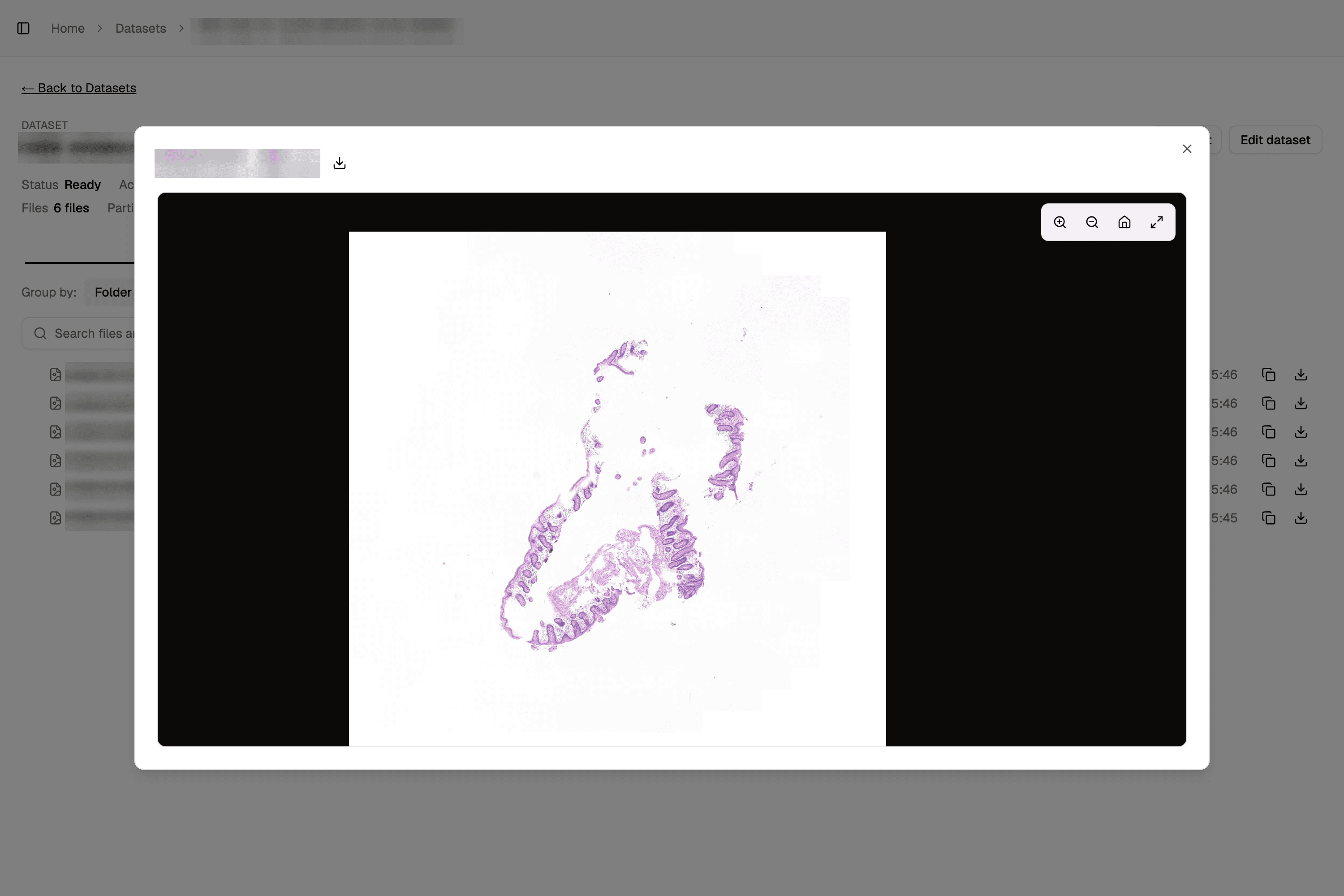
Digital pathology, in the browser.
Native support for digital pathology slide viewing.
Interested in using Foundry120, or exploring a research collaboration?
We’d be glad to hear from research groups and institutions exploring the platform, or holding data that has outgrown spreadsheets and shared drives.
Request a platform walkthrough →